
I told a CEO recently that he didn’t have the right to lead his company.
Harsh? Maybe. But after listening to him describe his week, 78 scheduled hours, zero strategic thinking time, constant firefighting, I asked him one question: “What are you teaching your team when the CEO doesn’t plan?”
The silence told me everything.
His calendar wasn’t just a personal productivity problem. It was a leadership failure. When leaders operate reactively, they model that intentionality is optional. Their teams mirror that chaos. Strategy gets delayed. Important work gets postponed. The organization optimizes for busy, not impactful.
Here’s what changed in 30 days when we rebuilt his executive calendar management system from scratch: He reclaimed 12 hours of deep work weekly, his direct reports stopped scheduling last-minute “urgent” meetings, and his leadership team started blocking their own strategic thinking time. The transformation wasn’t about doing more. It was about leading intentionally.
Here is why it matters and the the framework we used.
Why Smart Leaders Still Lose Control of Their Calendars
Your calendar is a leadership document. Every appointment is a statement about what matters.
Research from Harvard Business Review’s landmark CEO Time Study shows: “The way CEOs allocate their time and their presence is crucial, not only to their own effectiveness but also to the performance of their companies” (Porter & Nohria, 2018). This isn’t just about personal productivity; it’s about organizational impact.
The CEO I mentioned was working 78 hours weekly, but couldn’t tell me when he last had uninterrupted time to think about strategy. He’d convinced himself this was normal. That senior leadership meant being constantly available. That planning was a luxury he couldn’t afford.
But here’s what happens when leaders operate this way: Their chaos cascades. Direct reports learn that planning is optional. Meetings get scheduled without preparation. Strategic initiatives get perpetually postponed. The entire culture becomes reactive by default.
Are You Happy With the Return on Your Invested Time?
Research from McKinsey shows only 9% of executives are “very satisfied” with their current time allocation, and only 52% say their time matches strategic priorities (McKinsey, 2023). The dissatisfaction isn’t accidental. It’s the natural result of letting urgency drive the calendar instead of intentionality.
Think about your last week. How many fires did you fight that your team could have handled? How many “urgent” meetings interrupted deep work?
Now ask the harder question: What did you teach your team by operating that way?
Here’s the reframe that changes everything: Your calendar isn’t managing your time. It’s teaching your team what leadership looks like.
When you schedule back-to-back meetings with no prep time, you’re teaching your team that preparation is optional. When you skip your own blocked planning time because something “came up,” you’re teaching them that commitments to themselves don’t count.
The CEO from my opening story had a moment of clarity when I asked him: “If one of your directors operated the way you’re operating right now, what would you tell them?”
He paused. Then: “I’d tell them they’re not leading. They’re reacting.”
Exactly.
Your calendar either demonstrates intentionality or models chaos. There’s no middle ground. Your team is watching. What are you teaching them?
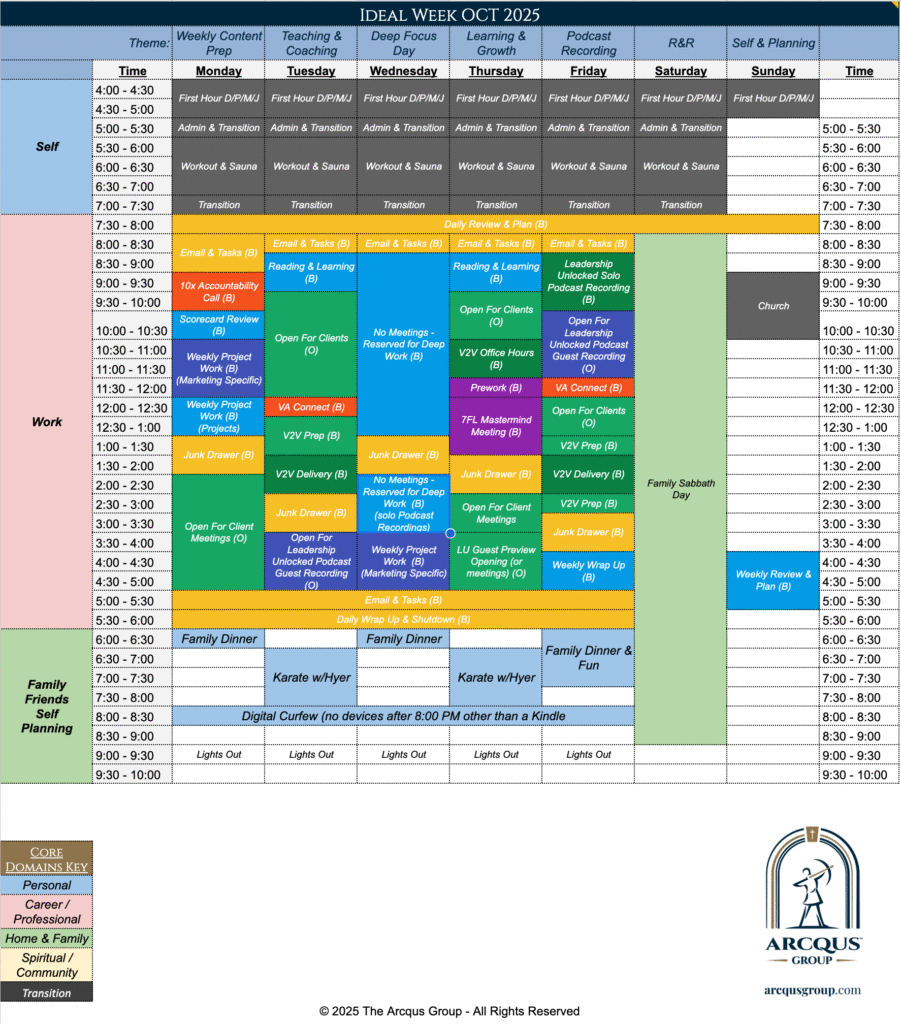
Below is an image from my actual Ideal Week Template from October 2025
The Three-Level Planning System
Most leaders try to plan their week without context. They look at Monday morning and start filling slots. That’s backward.
Here’s the framework that actually works:
Level 1: Anchor Your Year First
You can’t plan a week if you haven’t planned your year.
According to Harvard’s CEO Time Study, only 43% of CEO time actually advances strategic agendas, with some leaders as low as 14% (Porter & Nohria, 2018). The problem? They’re planning weeks without anchoring years. Strategic time doesn’t happen by accident. It happens by design.
Here’s how to start:
Block your non-negotiables first. Open your calendar for the next 12 months. Right now. Block every vacation day, every family commitment, every quarterly planning session you know you need. These aren’t things you “fit in later.” They’re the foundation.
Why? Because if you don’t claim this time proactively, someone else will claim it reactively.
The CEO I was coaching initially resisted this. “I can’t block vacation 12 months out. Things change.”
My response: “Things always change. The question is whether you’re changing your priorities to accommodate others, or whether others are accommodating your priorities.”
He blocked the time. The world didn’t end. His team adapted. Clients respected the boundaries. And for the first time in five years, he actually took his anniversary trip without working through it.
Block quarterly strategic planning days. These are full days, no meetings, no email, no distractions. You stepping back to assess, adjust, and plan the next 90 days.
Research from BCG shows that CEOs who protect time for strategic reflection report better insights into employees, customers, competitors, and market position (BCG, 2024). Annual anchoring is reflection made systematic, it’s how you ensure those insights actually drive your calendar.
Block weekly review and planning time. Friday afternoons or Sunday evenings. Recurring. Non-negotiable. This is where the annual plan becomes weekly execution.
Level 2: Theme Your Days
Context-switching is killing your effectiveness. Here’s how to stop it.
Research from Carnegie Mellon’s Software Engineering Institute shows that when executives work on five projects simultaneously, only 20% of their energy goes to actual work—80% is lost to context switching (Weinberg, Carnegie Mellon). Day theming eliminates this tax by keeping your brain in one cognitive lane per day.
Here’s how to implement:
Identify your core work categories. Most leaders have 4-6 primary types of work: client delivery, business development, team leadership, strategic planning, content creation, operations.
Assign themes to specific days. My week looks like this:
- Monday: Content creation and marketing
- Tuesday: Client coaching and teaching
- Wednesday: Deep work (no meetings scheduled)
- Thursday: Learning and professional development
- Friday: Podcast recording and weekly review
Notice what’s missing? Random task-switching. Every day has a primary cognitive mode.
Protect at least one meeting-free day or half-day. This is non-negotiable for strategic work. On my Wednesday deep work days, nothing gets scheduled. My team knows. My clients know. The calendar isn’t even available for booking.
What do I do with that time? The work that actually moves the business forward. Writing. Designing new frameworks. Planning quarterly strategy. Building systems. The stuff that never happens when you’re in reactive mode.
Level 3: Protect Your Transitions
Back-to-back meetings are the enemy of effective leadership.
Most leaders schedule meetings like Tetris, fitting pieces into every available space. Then they wonder why they’re exhausted by 2 pm despite “just sitting in meetings all day.”
Here’s what transition time gives you:
Preparation space. Five minutes before a meeting to review notes, recall context, and set objectives. This simple habit transforms meeting effectiveness.
Processing time. Ten minutes after a meeting to capture decisions, assign action items, and file notes. Without this, insights evaporate. Tasks fall through cracks.
Mental reset. Your brain needs time to shift between cognitive modes. The transition isn’t wasted time, it’s enabling time.
How to implement:
Set your default meeting length to 25 or 50 minutes, instead of 30 or 60 minutes. Block 15-minute buffers after every scheduled meeting. Build in longer transitions (30-60 minutes) between cognitively demanding sessions.
The leaders who resist this advice always say: “I don’t have time for transitions.”
And I always give the same answer: That’s exactly why you need them.
Building Your Ideal Week Template
Theory is worthless without implementation. Here’s how to turn these principles into a functioning system.
The Color-Coded Domain System
Your life has multiple domains: career, family, personal development, spiritual practice, health, community. Most leaders treat these as competing priorities instead of integrated systems.
The ideal week template uses color-coding to visualize how your time allocates across domains:
Career/Professional: Client work, business development, content creation. This is how you earn income and build professional impact.
Personal: Morning routines, workouts, personal development. This is how you maintain capacity to serve others well.
Home & Family: Family dinner, kids’ activities, date nights. This is why you work in the first place.
Spiritual/Community: Church, prayer time, community service. This is what grounds your leadership in something larger than yourself.
Transition: Buffer time between blocks. This is what makes everything else sustainable.
When Tuesday shows nothing but career from 6am to 8pm, you know something’s off. The calendar becomes a mirror showing whether your actions match your stated values.
Making the Template Work for You
Research on executive team performance found that higher-performing teams spend 54% more time setting direction, while lower performers spend 83% more time fighting fires (RHR International). When customizing your ideal week, the question isn’t “Can I fit in strategic time?” It’s “Can I afford not to?”
Start with your energy patterns. Are you a morning person or night owl? Structure your ideal week around your actual biology, not an aspirational version of yourself.
Honor your role requirements. A sales leader needs different theming than a CFO. The framework adapts, the principles don’t.
Build in flexibility. The ideal week is a template, not a prison. Some weeks require deviation. The goal is to return to the template as baseline.
The biggest mistake? Trying to go from zero structure to perfect ideal week overnight. Start with one themed day. Add annual anchors. Build transition blocks. Each element compounds. Progress beats perfection.
30-Day Implementation Roadmap
Week 1: Audit & Assess
Download your last 30 days of calendar data. Categorize every appointment as Career, Personal, Family, Spiritual, or Reactive. Calculate the percentages. Identify what keeps pulling you off course.
Most leaders discover they’re spending 60-80% of time on reactive work. Then they wonder why strategic initiatives never get traction.
Week 2: Annual Anchoring
Schedule next year’s vacations. Block quarterly strategic planning days. Add annual recurring commitments. Communicate these as non-negotiable to your team.
This feels uncomfortable. You’re claiming time 12 months in advance. But something important will always come up. The question is whether you’re important enough to deserve protected time.
Week 3: Day Theming
List your core work categories. Assign primary themes to each day. Update your scheduling tools to match your themes. Communicate the changes to your team.
Start with one themed day if full-week theming feels overwhelming. Make Wednesday your meeting-free deep work day. Protect it ruthlessly for 30 days. Then expand.
Week 4: Boundary Implementation
Add 15-minute transition blocks after every meeting. Change your meeting defaults to 25/50 minutes. Create template responses for boundary violations. Schedule your weekly review time.
Track these monthly: Hours of planned strategic work vs. reactive firefighting. Number of deep work blocks protected. Percentage of meetings with prep time. Do your actions match your stated priorities?
Conclusion
Your calendar is a leadership document. Every appointment is a statement about what matters. Every unplanned hour is a missed opportunity to model intentionality.
The CEO from the opening story transformed his organization not by working harder, but by planning smarter. His team learned that strategic thinking isn’t a luxury; it’s the job. A few months later, his leadership team had adopted the same framework. Meeting culture shifted. Strategic initiatives actually got completed. Revenue grew and results improved.
The question isn’t whether you have time to plan your ideal week. The question is whether you can afford not to.
Want the exact template we use? Click the button below, and you can download it (including an instructional video).
What’s currently preventing you from taking control of your calendar?
FAQ
Most executives see measurable results within 30 days. Week 1 reveals time allocation patterns. Weeks 2-3 reduce scheduling conflicts after blocking annual anchors and implementing day theming. The CEO case study reclaimed 12 hours weekly within one month, though full cultural transformation takes 90-180 days.
Time management focuses on personal productivity. Executive calendar management is about leadership influence. Your calendar teaches organizational priorities—when you schedule back-to-back meetings with no prep time, you’re modeling that preparation is optional. It’s a leadership document, not just a personal tool.
Yes. Day theming improves emergency responsiveness by preserving cognitive capacity. Research shows 80% energy loss from context-switching. Theme “Client Days” for reactive demands and “Strategic Days” for planning. Establish protocols defining genuine emergencies versus unplanned work. Most “urgent” requests are simply unplanned.
Frame boundaries as performance optimization with business rationale. Use data: only 52% of executives align time with priorities; high-performers spend 54% more time on strategy. Demonstrate value by tracking outcomes from protected strategic time. Show results, not just requests for accommodation.
Attempting perfection immediately instead of building progressively. Leaders try implementing everything at once and abandon the system within two weeks. The right approach layers changes over 90 days: audit, then annual anchors, then one themed day, expanding gradually. Progress beats perfection.
Traditional planning is reactive—filling Monday slots based on incoming requests. The three-level system is architectural: Level 1 anchors your year first, Level 2 themes days to eliminate context-switching, Level 3 protects transitions. It treats your calendar as a leadership document, not just a container.
This benefits any leader whose weight others rely on, CFOs, sales leaders, VPs, startup founders. The framework adapts to different roles. If you make decisions affecting multiple people or manage strategic outcomes beyond tactical execution, you need this system regardless of title.